




Contact number:
+86-15692113403
Exploring 4D Orthodontics: Reshaping the Core Logic of Clear Aligner Treatment | Dr.Clear Aligner Special Session Review at the 20th National Orthodontic Academic Conference
 Date:2022-01-10 10:19:28
 Author:Professional Marketing Department
 Views:22503
During the 20th National Orthodontic Academic Conference, the Dr.Clear Aligner special session under the theme "Smart Future, Go Clear" was held via cloud livestream from 9:00 AM to 12:00 PM on December 27, 2021, attracting widespread attention from academia and the industry. Three orthodontic experts were invited as speakers: Professor Xu Tianmin from Peking University School of Stomatology, Chief Physician Shu Guang from Peking University School of Stomatology, and Associate Chief Physician Mai Zhihui from the Third Affiliated Hospital of Sun Yat-sen University. They engaged in in-depth discussions on "Four-Dimensional Thinking in Digital Clear Aligner Orthodontics" and "Early Intervention Strategies," with multiple distinguished guests joining the livestream to share insights and provide valuable commentary on new concepts and technologies. This session presented the conceptual essence of 4D orthodontics, a brand-new modeling approach for clear aligner treatment, more precise tooth movement coordinate systems, occlusal plane and dynamic occlusion analysis, and more rational whole-periodic orthodontic intervention strategies for children and teenagers. By innovating the underlying logic, the session explored new opportunities and trends in the development of orthodontics in China. Below is a review of the highlights and key information from this session, intended to inspire orthodontic colleagues and broaden their vision for the future.
In This Issue:
• Understanding the concept of 4D orthodontics
• New achievements in clear aligner treatment under the 4D orthodontic philosophy
• How to reshape the underlying logic of clear aligner orthodontics
• Whole-periodic early intervention strategies for children and teenagers
Understanding 4D Orthodontics
Professor Xu Tianmin from Peking University School of Stomatology elaborated on the essence of 4D orthodontic diagnosis in his lecture, namely the impact of the time variable on the stomatognathic system. With changing times and disciplinary development, orthodontic diagnosis has gradually evolved from one-dimensional (Angle's classification of malocclusion based on the first permanent molar relationship), to two-dimensional (assessment of skeletal patterns through cephalometric analysis), to three-dimensional (three-dimensional diagnosis of sagittal, vertical, and transverse dimensions via CBCT). The next step will inevitably be toward four dimensions, primarily involving two major aspects: growth periods and occlusal growth patterns.
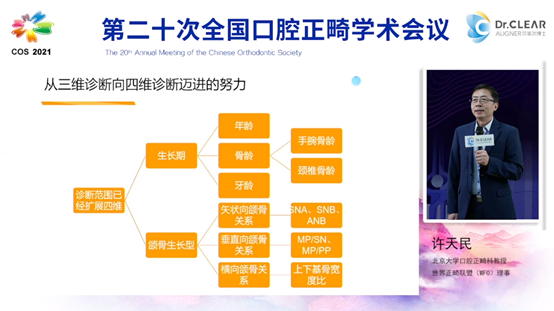
Mandibular advancement is a typical case requiring 4D diagnosis and treatment strategies. Through analysis and validation with actual cases, Professor Xu Tianmin emphasized that the "self-rotation" of teeth during growth and development with age must also be considered by orthodontists when making diagnoses and developing treatment plans. However, contemporary mainstream straight wire appliances are still three-dimensional appliances. If we re-examine the preset angles of straight wire appliances from a dynamic perspective—for example, by regulating the eruption growth trajectory of molars (downward and backward vertical growth) to achieve molar distalization—compared to the three-dimensional concept where orthodontic forces cause tooth movement to correct molar position or angulation, the four-dimensional concept views orthodontic forces as the cause of changing tooth movement states. We are currently in a transitional phase from 3D to 4D orthodontics, where space and time intertwine. We hope to expand conceptual thinking and clinical applications in this area, re-understanding the rotation and revolution of teeth in the four-dimensional universe of space-time changes, helping the orthodontic operating system "upgrade dimensions," establishing a new and more comprehensive diagnostic and treatment system, and mastering the orthodontic "metaverse."
Insightful Data, Clear Treatment Planning
Chief Physician Shu Guang from Peking University School of Stomatology presented a lecture on the fundamental reconstruction of clear aligner treatment under the 4D orthodontic philosophy. In orthodontic treatment, the initial position determines treatment goals and treatment plan design. However, there are currently many debatable issues in clear aligner treatment: Is the data in digital systems comprehensive and accurate? Should only static target positions be designed? Are tooth movement amounts reliable? Is occlusal jumping feasible? Are there other key variables in the mechanical system of clear aligners? In response to these questions, Dr. Shu analyzed the differences between fixed appliance and clear aligner clinical diagnosis and treatment models, pointed out deficiencies in the modeling of contemporary mainstream clear aligner systems—such as problems with the initial occlusal plane angle in tooth arrangement software—and analyzed the adverse effects of improper occlusal plane positioning on treatment (e.g., anterior torque, smile line design) as well as the necessity of establishing dynamic occlusion models. Therefore, Dr. Shu demonstrated modeling methods to further improve occlusal plane accuracy to enhance the precision of anterior torque design and expression, and for the first time presented a dynamic occlusion model incorporating a time axis in clear aligner treatment, more comprehensively displaying patients' functional occlusal status and growth and development conditions, making clear aligner diagnosis and design more precise.
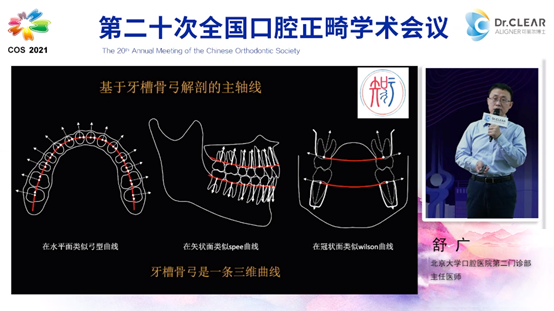
The measurement of tooth movement is critical to the safety of treatment design and the feasibility of anchorage design. Currently, there are errors in the coordinate systems commonly used in clear aligner systems. Dr. Shu used specific cases to demonstrate errors in tooth movement measurements in previous systems and analyzed their causes. Due to incorrect coordinate selection, malpositioned teeth—such as labially or lingually inclined teeth—affect the measurement of buccolingual and vertical movement; rotated teeth affect mesiodistal and buccolingual movement measurements; and tipped teeth affect mesiodistal and vertical movement measurements. To address these issues, Dr. Shu invented a new tooth movement measurement coordinate system based on the alveolar bone arch, which accurately reflects tooth movement relative to the alveolus. Labial inclination, rotation, or axial tipping of teeth does not affect the judgment of tooth movement direction or amount. The measurement data from this coordinate system can provide oral clinicians with more reliable diagnostic and design evidence. Based on the new model and coordinate system, Dr. Shu explored the development of new algorithms for clear aligner systems and proposed the possibility of optimizing attachment design, reasonable overcorrection and anchorage preparation, and increasing step types to achieve healthy and efficient treatment outcomes through simple and reliable treatment plan design.
Reshaping the Core Logic of Clear Aligner Orthodontics
The Dr.Clear system incorporates the aforementioned clear aligner technology with independent intellectual property rights from China. Based on the philosophy of 4D orthodontics and a holistic perspective, it employs brand-new modeling methods and movement algorithms, fundamentally changing the underlying logic of clear aligner treatment. It offers three main advantages: ① Four-dimensional digital models: including root-bone system, soft tissue system, occlusal plane calibration and reconstruction functions, dynamic occlusion analysis, occlusal jumping function, growth models, and bone remodeling models, providing reliable diagnostic evidence with more realistic and comprehensive clinical information; ② Curved surface coordinate system: a four-dimensional measurement tool based on anatomy and physiology, using accurate tooth movement and growth data to provide reliable treatment plan design evidence; ③ Innovative intelligent algorithms: including treatment position design, intelligent staging, fully optimized attachments, occlusal balance treatment system, and intermaxillary multi-purpose adjustment devices, to enhance support for treatment plan expression. The new system is designed by orthodontists and for orthodontists, effectively addressing common issues in current clear aligner treatment, improving clinician efficiency, and reducing clinical risks. Indeed, the refinement of this new system requires close integration with clinical practice at all times. We hope that by pooling the wisdom of industry experts, scholars, and clinical practitioners, we can work together to further elevate the level of clear aligner treatment in China.
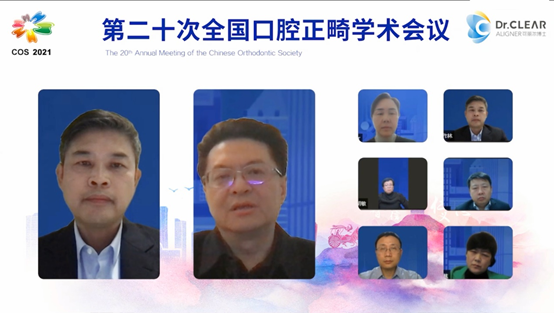
There is still much work to be done in future research and clinical practice, and this has received strong support from industry experts. Professor Jin Zuolin from the Orthodontic Committee of the Chinese Stomatological Association and the Air Force Medical University School of Stomatology, Professor Zhao Zhihe, Vice Dean of West China Hospital of Stomatology at Sichuan University, Professor Hu Min, Dean of the Hospital of Stomatology at Jilin University, Professor He Hong from the Hospital of Stomatology at Wuhan University, Professor Guo Jie, Vice Dean of the School of Stomatology at Shandong University, and Professor Liu Lin, Vice Dean of Dalian Stomatological Hospital—six distinguished guests shared their insights and feedback on this technological achievement through online discussions and commentary, offering positive suggestions for improvement and development. The experts unanimously recognized the reconstruction of the underlying logic of orthodontics, which represents a milestone achievement in clinical diagnosis.
Flexible Whole-Periodic Orthodontic Management
Associate Chief Physician Mai Zhihui from the Third Affiliated Hospital of Sun Yat-sen University delivered a lecture on "Early Intervention Strategies for Malocclusion in the Mixed Dentition Period," providing a comprehensive, systematic, detailed, and rich course sharing, including the main types of malocclusion in the mixed dentition period, the causes of malocclusion during this period, and key knowledge points on craniofacial skeletal development in children, supplemented by representative case analyses of anterior crossbite, mandibular retrusion, and dental arch space management—a truly valuable lecture for clinicians.
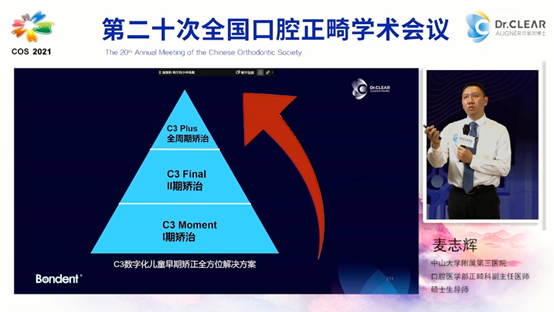
Among the main types of malocclusion in the mixed dentition period, the following were highlighted: maxillary protrusion with mandibular retrusion; maxillary deficiency with mandibular excess; deep overbite or open bite of anterior teeth; premature loss of mixed dentition space; and maxillary arch constriction. The main causes of malocclusion during the mixed dentition period include: airway obstruction and mouth breathing; oral habits; overly refined diets leading to insufficient stimulation of the dental arch and jawbone, resulting in arch constriction; and premature loss of primary teeth due to caries or periapical diseases. Regarding craniofacial skeletal development in children, the speaker emphasized that 60% of facial development is completed before age 4, and 60%–90% is completed between ages 6 and 12, making early intervention during this period particularly important.
The main components of early treatment during the mixed dentition period are: ① Eliminating oral habits and establishing balanced muscular forces inside and outside the dental arch; ② Advancing the mandible and inhibiting excessive maxillary growth (skeletal Class II); ③ Resolving anterior crossbite and releasing the growth potential of the maxilla (skeletal Class III); ④ Expanding the dental arch and resolving posterior crossbite; ⑤ Managing space within the dental arch to facilitate proper eruption of permanent teeth. For the growth and development of children aged 3–12, there are products on the market that integrate silicone-based myofunctional appliances, functional removable appliances, and early clear aligner orthodontic systems, which can address almost all issues encountered in early treatment.
In recent years, clear aligner treatment has developed rapidly, yet many unresolved questions remain worthy of further exploration. Just as the concepts of "4D orthodontics" and "whole-periodic early treatment management" presented at this session have become or will become new industry hotspots, it is gratifying that numerous orthodontic experts, scholars, and clinicians in the industry are continuously summarizing experience, actively investing in researching new directions, and committed to creating new concepts and technologies based on the characteristics of clear aligner technology, improving its efficiency, reliability, and safety, and continuously achieving new clinical application progress. This will undoubtedly elevate the level of clear aligner treatment in China to new heights and will also influence the development of orthodontics worldwide.
Those who climb mountains undeterred by difficulty will surely reach the summit. Let us wait and see!
Recommended Articles
- The 2nd National Academic Conference for Young and Mid-Career Orthodontists
- Invitation丨South China Exhibition Academic Conference Awaits Your Presence~
- Exploring 4D Orthodontics: Reshaping the Core Logic of Clear Aligner Treatment | Dr.Clear Aligner Special Session Review at the 20th National Orthodontic Academic Conference
- Dr.Clear Aligner June VIP Conference Now Enrolling
- Dr.Clear Aligner | Invitation to 2020 Shanghai CDS Dental Exhibition
- Event Recap | Dr.Clear Aligner Thinking Training Series Xiamen Station Successfully Concluded!